


Healthcare teams worldwide face nursing shortages, aging populations, and gaps in clinical visibility, especially during care transitions. As patients move from hospital to skilled nursing facilities or home healthcare, vital sign baseline data often disappears, leaving incoming teams without reference points they need to recognize changes in patient status earlier.
During care transitions, this issue worsens. With eight-hour vital sign checks as standard, 16-hour gaps overnight can occur, so gradual changes go unnoticed.
What Happens During Care Transitions Without Continuous Patient Monitoring
In a recent webinar, Clinical Innovation and Excellence Officer Janice Larmond shared a case that plays out daily across healthcare settings. A 72-year-old on new heart medication was discharged Friday to a skilled nursing facility with a heart rate baseline of 70 bpm.
At the skilled nursing facility, his intake assessment showed a stable heart rate of 75 bpm. The facility followed protocol with vital sign checks every eight hours. Everything appeared within normal range.
By Wednesday, the patient was in crisis, with a heart rate of 118 and acute palpitations. The patient was transferred to the emergency department (ED) for a three-day readmission.
What was missed? By Monday, the patient’s heart rate had increased 40% from his hospital baseline. This was clinically significant, but the facility’s spot checks showed his heart rate within “normal” limits.
The gap in data meant the trend in his heart rate went unrecognized, turning a manageable medication adjustment into an emergency intervention.
If continuous monitoring had been in place, the patient’s changing status could have been detected earlier, enabling proactive care and reducing the risk of emergency interventions and readmissions.
How Continuous Patient Monitoring Addresses Challenges in Care Transition
Janice outlined three clinical challenges that continuous patient monitoring addresses during care transitions:
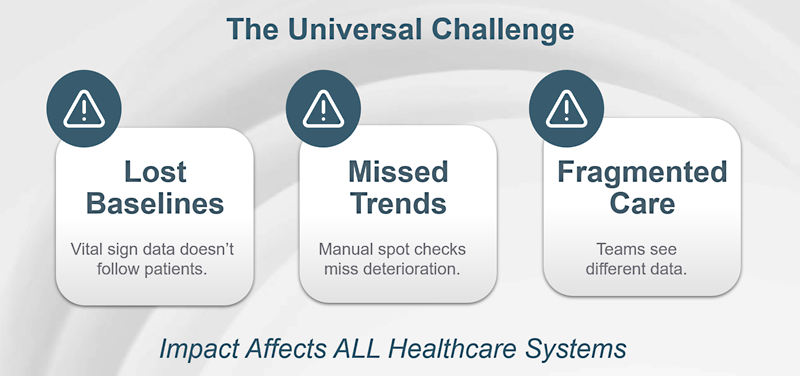
Lost baselines: When patients transition between care settings, their physiological trends don’t follow them. Care teams lack reference points.
Missing trends: Using spot checks six to eight hours apart creates gaps in vital sign data, allowing gradual changes to go unnoticed until intensive intervention is needed.
Fragmented coordination: Multiple team members observe signs in isolation, without recognizing patterns that matter.
In another case, a home healthcare nurse, without trend data to support her clinical judgment, chose a conservative course, sending a recovering pneumonia patient to the emergency department.
If she had been able to review 48 hours of respiratory patterns across the care transition, she would likely have recognized progressive changes and coordinated a clinic visit, avoiding unnecessary ED use and addressing the patient’s needs.
What Makes Continuous Patient Monitoring Effective for Care Transitions
In a retrospective study, Neteera’s FDA-cleared, CE-certified by NB 2797, continuous contactless patient monitoring system demonstrated detection of clinical changes up to five days before hospitalization, with 77% detection accuracy.
Neteera’s passive technology requires no wearables, cameras, or patient compliance. It extends clinical visibility across care transitions and between assessments without adding burden to care teams.
This changes how teams manage care transitions. Rather than reacting to crises, clinicians can identify which patients need attention first based on physiological trends, not just scheduled checks. The system answers a different question: not “how is the patient right now?” but “how is the patient changing over time?”
The Path Forward With Continuous Monitoring in Care Transitions
Whether you’re managing workforce constraints in the US or navigating EHR adoption across the EU, the clinical challenge remains: how do you provide proactive care when you can’t be everywhere at once?
Continuous patient monitoring during care transitions addresses this by extending clinical visibility between assessments, giving your teams the trending data they need to identify which patients require attention before situations escalate.
Watch the full webinar to hear Janice Larmond discuss additional case studies and answer common implementation questions about continuous monitoring in care transitions.