


Healthcare stands at a critical crossroads. By 2030, the Centers for Medicare and Medicaid Services (CMS) aims for all providers to operate under value-based care (VBC) models. Yet, according to healthcare policy expert Dr. Terry Sullivan, the industry faces a fundamental challenge: “Healthcare systems are being asked to change how they operate at a core level. That’s only achievable and sustainable if there’s help doing the heavy lifting of managing data, tracking and evaluating performance, and coordinating care.”
These are additional tasks that can’t realistically be added to already overburdened healthcare workers. Bridging this operational gap is one of the most significant obstacles facing healthcare today. For organizations to meet their goals, remain competitive, and improve care, technology that automates manual tasks and frees up clinicians to do what they do best is essential.
In this article, we look at the role of healthcare automation in achieving success with value-based care. Internist and public health physician Dr. Terry Sullivan joins us to explore how technology serves as the missing link between current healthcare operations and VBC requirements, the three critical roles technology plays in value-based models, and how organizations can strategically implement solutions to thrive in the transformed landscape.

Dr. Sullivan is an internist and public health physician. He serves as a consultant for Neteera, with previous experience as the chair of the Colorado Board of Health and regional CMO for multiple managed care organizations, including Humana.
Unsustainable Healthcare Labor Economics
The numbers tell a stark story about why the current healthcare model cannot continue without significant technological intervention.
“56% of hospital expenses are labor-related,” Sullivan explains. That percentage makes it clear that healthcare’s highly trained staff should spend their time doing things that require their skills. Documentation and data collection tasks rarely fall into this category.
Healthcare’s labor-intensive approach creates multiple problems:
- Cost inflation that outpaces value: While many industries see prices decrease relative to quality over time, healthcare costs continue to rise disproportionately to quality improvements.
- Workforce shortages: The healthcare industry consistently reports staffing challenges, yet the solution isn’t necessarily hiring more people.
- Inefficient resource allocation: High-skilled clinicians spend significant time on tasks that technology could handle more efficiently.
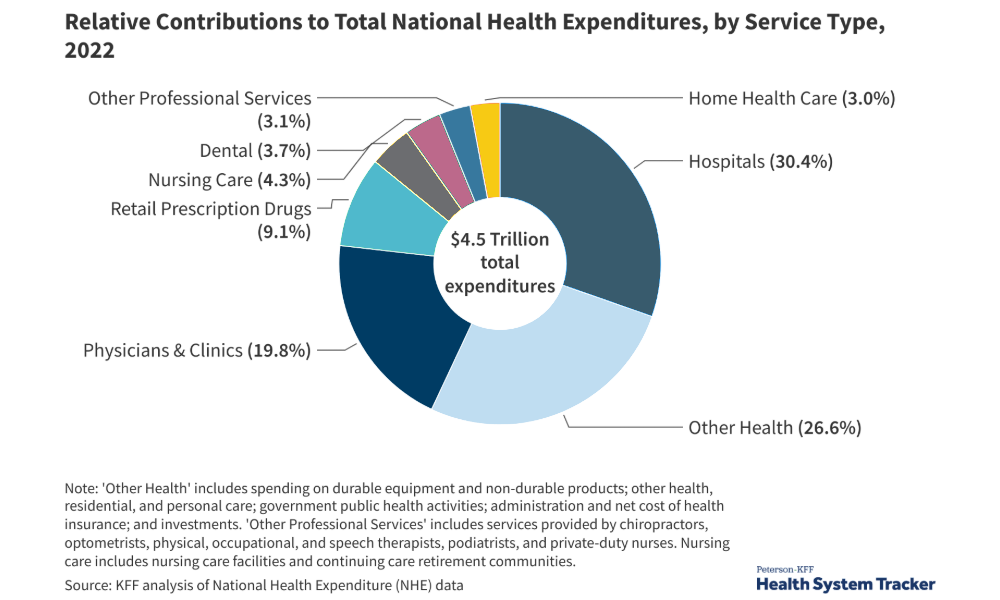
Source: Health Care Costs and Affordability
Why do these problems plague healthcare more than other industries? One clue can be found in how different sectors adopt and advance using technology and automation.
VBC Demands Technology
Value-based care changes the economic equation for healthcare providers. Instead of being rewarded for volume—more patients, more procedures, more hospitalizations—providers receive payments based on patient outcomes and cost efficiency.
“Value-based care is a system based on measurement. It looks at quality metrics and patient outcomes, not just volume.” Sullivan notes.
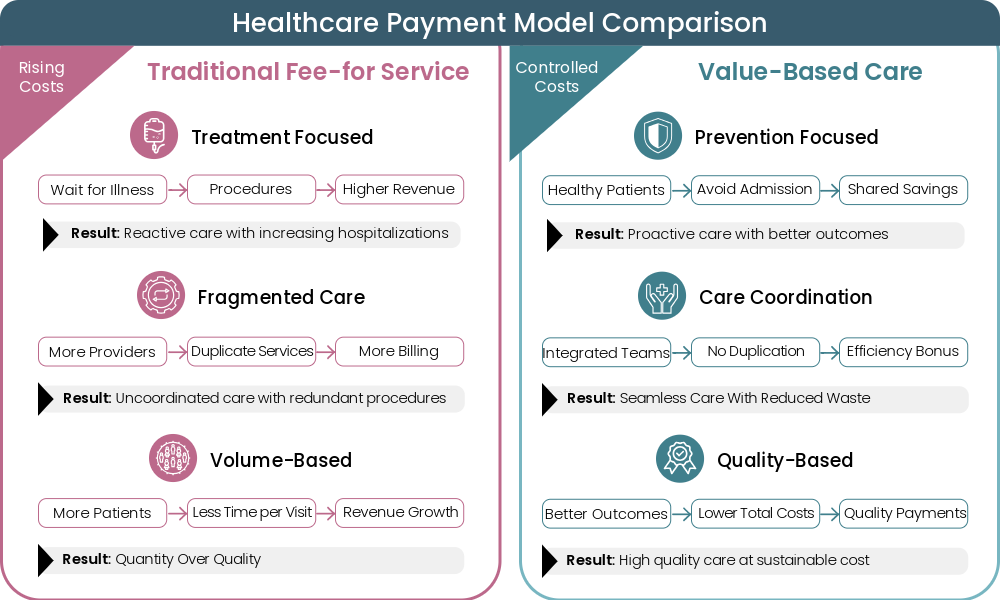
Payment models aligning with VBC incentivize:
- Prevention over treatment: Keeping patients well is more cost-effective than additional treatment, increased hospitalization, and longer stays.
- Care coordination: Avoiding duplicate services and unneeded procedures
- Efficiency improvements: Delivering care at lower costs without reducing quality benefits both providers and payers.
Without technology, achieving efficiency goals while maintaining or improving care quality becomes mathematically impossible. The human-only approach can’t scale to meet the demands of value-based care. Yet, human touch can’t be replaced in care, with studies showing its importance in patient outcomes and satisfaction.
3 Roles of Technology in Value-Based Care
Technology in the value-based care environment serves three essential functions:
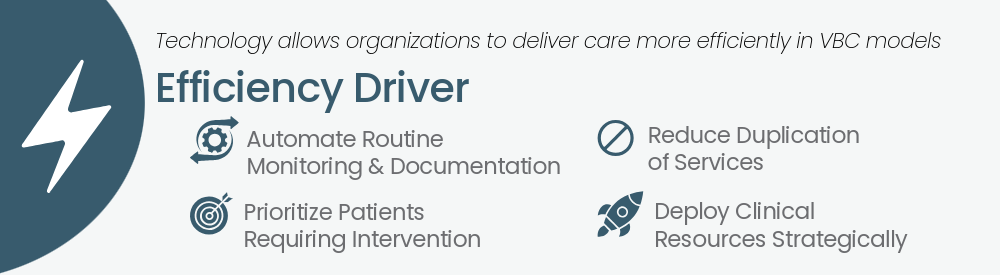
1. Efficiency Driver
In a VBC model, providers must find ways to deliver care more efficiently.
Technology allows organizations to:
- Automate routine monitoring and documentation
- Prioritize patients requiring intervention
- Reduce duplication of services
- Deploy clinical resources strategically
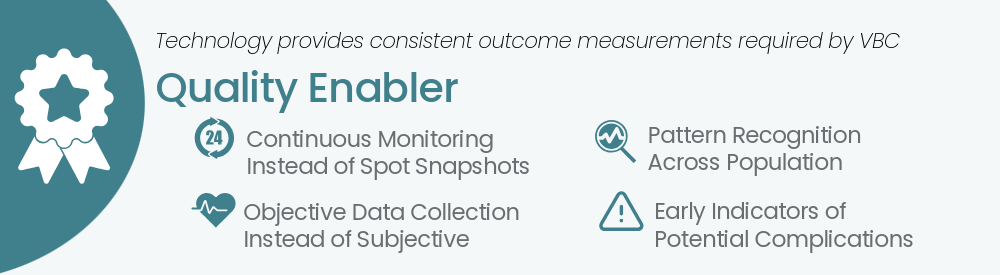
2. Quality Enabler
Consistent measurement of outcomes is a requirement of value-based care.
Technology provides:
- Continuous patient monitoring instead of point-in-time snapshots
- Objective data collection rather than subjective reporting
- Pattern recognition across patient populations
- Early warning indicators for potential complications
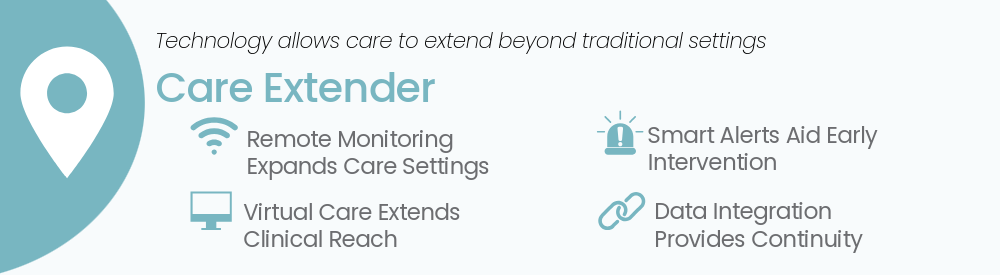
3. Care Extender
Perhaps most importantly for the future, technology allows care to extend beyond traditional settings:
- Remote monitoring enables home-based management of chronic conditions.
- Smart alerts can help staff intervene early to reduce unnecessary hospital transfers or ER visits.
- Virtual care extends clinical reach without corresponding staffing increases.
- Data integration provides continuity across care settings.
For example, a recent study conducted by Neteera in collaboration with TapestryHealth showed that continuous patient monitoring can provide up to 5 days of advanced warning before hospitalization is necessary. This warning period extends the time care teams have to assess and treat conditions to avoid hospitalizations, improve patient outcomes, and increase patient satisfaction.
Competitive Advantage and Technology Adoption
Currently, providers fall into three categories:
Laggards: Resist integrating technology into workflows and are primarily concerned with preserving traditional care models and roles. These organizations will struggle to remain financially viable under value-based care payment models.
Adapters: Implement technology primarily for compliance purposes, without realizing all possible benefits. These organizations may survive, but won’t thrive in the value-based environment.
Innovators: Embrace technology as a strategic advantage and redesign care delivery models around technological capabilities. Positioned to lead in the value-based future.
“Driving competition under a value-based model improves things across the industry for patients. Competition’s what is needed,” Sullivan emphasizes.
Choosing the Right Technology
Not all healthcare technology delivers equal value in the shift to value-based care.
Organizations should prioritize technologies that:
- Generate actionable data: Delivers insights that can inform care decisions, rather than just collect data.
- Integrate easily: Doesn’t create data silos or require duplicate documentation.
- Focus on outcomes: Provides a demonstrated connection to improving patient outcomes, not just operational metrics.
- Enhance clinician judgment: Augments clinical expertise rather than attempting to substitute for it.

Technology Implementation: Beyond the Purchase
Successfully leveraging technology in value-based care requires more than simply acquiring systems.
Organizations must address:
- Workflow integration: Technology that doesn’t fit naturally into clinical workflows will face resistance and underutilization.
- Staff training: Clinicians and staff need both technical training and education on how the technology supports care objectives.
- Patient engagement: Patients must understand and accept technology’s role in their care experience.
- Data utilization strategy: Organizations need processes in place to act on the data that the technology generates.
Next Steps in Your Facility’s VBC Shift
The transition to value-based care fundamentally changes healthcare economics. Organizations that continue operating with minimal technological support will find themselves increasingly unable to compete in a fixed-budget environment.
The good news is that technology adoption doesn’t require abandoning healthcare’s core values. Instead, it allows organizations to refocus human resources on the aspects of care that most benefit from human touch, while leveraging technology for data collection and analysis, patient monitoring, and routine tasks.
The real question for the future isn’t whether technology will transform healthcare—it’s which organizations will lead the transformation and which will struggle to catch up. It’s a clear opportunity: embrace technology as an essential enabler of value-based care, and position your organization for success in healthcare’s inevitable future.
This article is part of a series on value-based care. You may also like Creating Effective Home-Based Care Systems in a Value-Based World and Will Value-Based Care Transform Healthcare Economics by 2030?