


KEY TAKEAWAYS
♦ Pulse oximetry measurements don’t indicate adequate ventilation or provide information on deterioration.
♦ Respiratory rate is the first vital sign to exceed normal values across nearly all forms of clinical decline.
♦ Research across nearly 270,000 admissions found that vital sign trends significantly improved early detection of deterioration.
♦ In 71.8% of readings, respiratory rate was documented as 18 or 20 brpm, suggesting estimation, not measurement.
♦ If distress is observable, the underlying condition may be beyond treat-in-place care.
Busting Common Misconceptions About Vital Sign Monitoring in Skilled Nursing Facilities
Every shift, care teams record vital signs, document the readings, and move on if the results are stable, confident that the resident is also stable. Five common assumptions about vital sign monitoring in skilled nursing facilities make that confidence harder to justify than most protocols acknowledge.
While much of the research behind these myths comes from acute care settings, the clinical dynamics described aren’t unique to hospitals. The body’s early warning signals, the limitations of manual measurement, and the consequences of missed detection follow the same patterns in post-acute care.
These five myths are rooted in reasonable assumptions, traditional protocols, and training standards. Yet each one has a research record showing the assumption isn’t holding up the way teams expect.

MYTH BUSTED
“If SpO2 looks normal, the resident is fine.”
SpO2 and respiratory rate aren’t measuring the same thing.
Treating them as interchangeable has real clinical consequences.
Pulse oximetry measures hemoglobin saturation. It doesn’t tell you whether a resident is breathing effectively. Those are two different measures.
A resident can show a normal SpO2 reading while their respiratory rate (RR) signals that something is wrong, especially if they’re on supplemental oxygen.
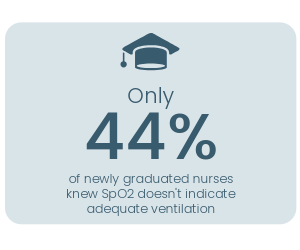
This knowledge gap is well documented. In a survey of 300 newly graduated nurses, only 44% knew that oxygen saturation isn’t an indicator of adequate ventilation. In a separate study of ICU, emergency department, and anesthesiology nurses, more than half were unaware that pulse oximetry doesn’t reliably indicate adequate ventilation.
Research identifies respiratory rate as the vital sign whose normal values are exceeded earliest, before any other vital sign, across nearly all forms of clinical decline. By the time SpO2 drops, the body has often been compensating for some time.
Studies also link changes in respiratory rate to the earliest signs of sepsis, systemic inflammatory response syndrome, shock, and respiratory insufficiency.
Respiratory rate is a strong predictor of early patient deterioration and cardiac arrest, and an early indicator of hypoxia, hypercapnia, and metabolic and respiratory acidosis.
Despite this, RR is consistently the most under-monitored vital sign in skilled nursing facilities. One study found that only 12% of nurses identified it as the most important indicator of deterioration, and only 27% captured it for all medical/surgical patients. Studies report that it was missed 76% to 83% of the time when other vital signs were recorded.

MYTH BUSTED
“If periodic vital signs are stable, the resident is fine.”
Without an individual baseline, “stable” is relative.
A reading taken during rounds tells you where a resident falls relative to a population average. It doesn’t tell you whether something has shifted for them.
A single measurement can look unremarkable in the moment but tell a different story when considered alongside what happened in the hours or days before.
Clinical deterioration doesn’t pause between check-ins. Changes that signal worsening conditions often begin hours or days earlier.
A single vital sign check is a snapshot in time. Deterioration is a trend. Early deterioration detection depends on having enough data points to see that trend develop, something that periodic rounds can’t reliably provide.
Research examining nearly 270,000 patient admissions found that vital sign trends significantly improved the detection of clinical deterioration. Direction and rate of change offer far more clinical meaning than a single reading. A respiratory rate of 20 means something different to your nurses when they know it was 16 three days ago.
In many SNFs, care teams don’t have consistent measurements to stitch together for a broader view of individual resident well-being. That visibility gap widens when tight staffing ratios make manual measurement more difficult.
Missed measurements contribute to missed diagnoses. The opportunity to prevent hospitalization decreases when early changes aren’t detected until a scheduled round captures them.
What a stable periodic reading can’t tell you:
- Whether that reading is the high or low point of a resident’s fluctuating trend
- That RR has been creeping upward since yesterday’s shift
- Whether that value represents a meaningful change from the resident’s personal baseline
- Whether deterioration started and progressed between the last two rounds
The issue isn’t rounds themselves. It’s that intermittent measurements can’t capture a trend developing continuously between them.

MYTH BUSTED
“If the resident is breathing normally, their respiratory rate is fine.”
A resident can look comfortable while their respiratory rate signals otherwise.
Visual assessment is a reasonable starting point. If you can see something is obviously wrong by the way a resident looks or moves, that’s useful information. But visible signs of distress are a late indicator, not an early one.
Significant changes in breathing effort can occur without the resident feeling or showing anything. By the time they’re visibly laboring to breathe, conditions may have already progressed beyond what treat-in-place care can manage.
Research consistently shows that the body offers early signals before deterioration becomes visible. One study found that nearly 80% of patients experiencing in-hospital cardiac arrest showed clinical signs hours before the event.
As the body responds to early threats, including infection, sepsis, fluid accumulation, and metabolic disturbances, RR is often the first vital sign to change. The warning is there, but detecting and acting on it depends on taking the right measurement at the right time with the right context.
This matters especially in post-acute care, where residents may have a blunted awareness of their own distress. Older adults, those with cognitive impairment, and residents managing chronic conditions may not report that something feels wrong, even when their physiology is signaling it. Relying on what a resident reports or what the staff sees is a reactive approach to deterioration that is likely advanced.
What visual observation can’t tell you:
- That the respiratory rate has been gradually increasing over the past 12 hours
- That a rate of 22 today represents a meaningful shift from three days ago
- That distress is developing before visible signs appear
- That a resident who looks comfortable is moving toward a clinical threshold
Research has shown that continuous monitoring detects more cases of sustained respiratory abnormalities than intermittent measurements, which is clinically significant when the goal is catching deterioration early enough to change the outcome.

MYTH BUSTED
“If a respiratory rate is documented, it's accurate.”
A documented respiratory rate isn’t necessarily a measured one.
For a vital sign this sensitive to early deterioration, that difference has real clinical stakes in skilled nursing facility care.
Accurate RR measurement depends on consistent technique and complete documentation — two things that research shows rarely happen in practice.

Respiratory rate is the vital sign most likely to be missed, estimated, or recorded incorrectly. Studies report it wasn’t entered 76% to 83% of the time when other vital signs were recorded.
When it is documented, research shows that 71.8% of the time it’s recorded as exactly 18 or 20 breaths per minute, even though those two values appear in only around 13% of actual measured data. Those round numbers are a sign of estimating, not measuring.
A review of 19 studies found that estimation and clustering around 16, 18, and 20 breaths per minute are common practices across medical and surgical wards. Staff often estimate a standard rate for residents who appear well and count carefully only for those who already look unwell, eliminating the value RR can deliver in detecting decline earlier.
Technique also factors in. Counting for 15 or 30 seconds and multiplying rather than counting a full 60 seconds can result in an average underestimation of two breaths per minute. In early warning scoring systems, that difference can mean a clinical review gets missed.
Respiratory rate can be documented incorrectly in five distinct ways:
- The reading is skipped entirely.
- Careful counting only happens when a resident already looks unwell.
- A visual guess replaces an actual count.
- Counting for less than a full 60 seconds and multiplying the result produces an inaccurate count.
- Residents change their breathing when they know they’re being watched.
What a manual reading can’t reliably provide:
- A trend over time
- Data captured between rounds
- A count uninfluenced by how the resident looks
- Consistency across staff and shifts

MYTH BUSTED
“Respiratory rate only matters for residents with a pulmonary diagnosis.”
Respiratory rate is a systemic signal, not a pulmonary one
The association between RR and pulmonary diagnosis is reasonable, but it’s incomplete.
Research published in the Joint Commission Journal on Quality and Patient Safety identifies respiratory rate as the vital sign whose normal values are exceeded first, across nearly all forms of clinical decline, regardless of whether the underlying condition is respiratory. This includes:
- Sepsis and systemic inflammatory response syndrome
- Shock
- Cardiac events, including the lead-up to unexpected cardiac arrest
- Metabolic disturbances, including acidosis
In skilled nursing facilities, this matters in a particular way. Residents often present with multiple comorbidities, and deterioration may not follow a clear diagnostic path. A resident whose primary diagnosis is cardiac, orthopedic, or neurological may still show the first sign of systemic change through a shift in respiratory rate, before any condition-specific symptoms appear.
Rethinking Vital Sign Monitoring in Skilled Nursing Facilities
Each of these five myths points to the same limitation: intermittent, manual monitoring creates gaps in accuracy and the clinical picture available to care teams. Those gaps widen further when staffing ratios make consistent measurement harder to achieve.
The consequences are more than clinical. Avoidable hospitalizations affect outcomes, operations, and the trust families place in your facility. When deterioration that could have been caught earlier results in an emergency transfer, questions about your monitoring protocol follow.
Closing visibility gaps requires a different approach to data collection. Continuous monitoring technology is available that automatically and accurately measures residents’ vital signs without staff involvement. The first step is an honest assessment of what your current monitoring protocol can and can’t tell you about a resident who isn’t showing any visible signs of decline.
FAQs
Is pulse oximetry enough to monitor respiratory status in skilled nursing facility residents?
No. Pulse oximetry measures hemoglobin saturation, not ventilation. A resident can show a normal SpO2 reading while their respiratory rate signals early deterioration — particularly if they’re on supplemental oxygen. Research identifies respiratory rate as the vital sign whose normal values are exceeded first across nearly all forms of clinical decline.
How reliable are manually documented respiratory rates in skilled nursing facilities?
Research shows that respiratory rate is the vital sign most likely to be missed, estimated, or recorded inaccurately. Studies report that it goes undocumented 76% to 83% of the time when other vital signs are recorded. When it is documented, 71.8% of readings are recorded as exactly 18 or 20 breaths per minute, indicating a pattern consistent with estimation rather than measurement.
Can care teams detect resident deterioration between rounds?
Not reliably with manual monitoring alone. Clinical deterioration often begins hours or days before it becomes visible, and intermittent rounds capture only a snapshot in time. Research examining nearly 270,000 patient admissions found that vital-sign trends significantly improved deterioration detection, and continuous measurement data is needed to generate those trends.
Does respiratory rate only matter for residents with a pulmonary diagnosis?
No. Respiratory rate is a systemic signal, not a pulmonary one. Research identifies it as the first vital sign to exceed normal values across sepsis, shock, cardiac events, and metabolic disturbances, regardless of the resident’s primary diagnosis. In SNFs, where residents commonly present with multiple comorbidities, this makes RR monitoring relevant across the entire population.
What are the operational risks of gaps in vital sign monitoring for SNF operators?
Avoidable hospitalizations affect quality metrics, revenue, and family trust. When deterioration that could have been detected earlier results in an emergency transfer, it raises questions about monitoring protocols with families, discharge planners, and referral sources. Consistent, accurate vital sign data creates a documented record of clinical awareness that protects both residents and the facility.
Concerned about what your current monitoring protocol might be missing? See how the Neteera System gives SNF care teams continuous, contactless visibility into resident status, so deterioration shows up as a trend, not a surprise.
Learn more or request a demo →