


How do you improve patient outcomes and experience when you’re working with fewer staff and tighter budgets? This question keeps healthcare leaders up at night—from the CNO focused on nurse workload to the administrator balancing quality metrics against operational costs.
Any solution needs to support the patient-nurse relationship—key to both patient and clinician satisfaction—while easing demands on nurses already stretched thin. Automated patient monitoring addresses both, freeing clinical staff for hands-on care by reducing manual tasks. Finding the right solution for your needs starts with comparing the genuine strengths and real limitations of wearable and contactless monitoring options.
This article explores the wearables vs. contactless monitoring discussion, offering the pros and cons of both approaches and what to consider when deciding which technology makes the most sense.
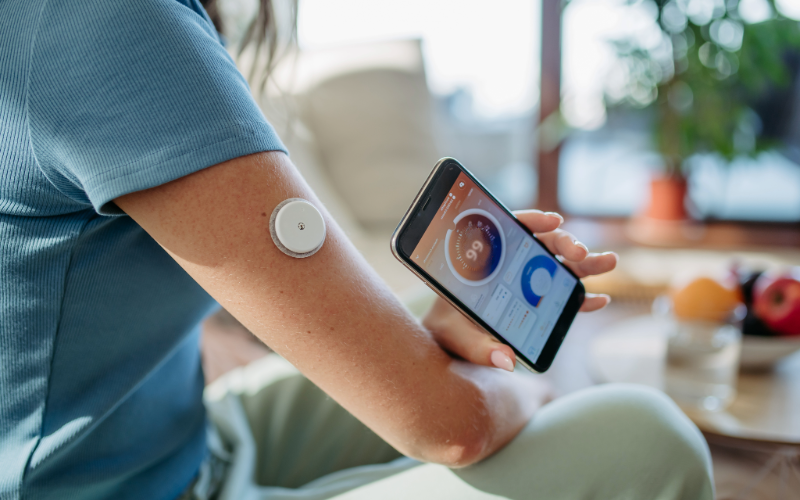
Understanding Wearable Patient Monitoring
What Are Wearables?
Wearable monitoring devices attach directly to the patient’s body to measure physiological data. They come in several form factors:
Smartwatches and wristbands – Usually capable of tracking heart rate, activity, sleep patterns, and sometimes blood oxygen or temperature
Patches – Adhesive sensors placed directly on the skin can monitor blood pressure, heart rate, and body temperature, along with certain biochemical markers.
Rings – Measure heart rate and variability, blood oxygen saturation, sleep quality, and activity
Continuous glucose monitors (CGMs) – Small sensors inserted under the skin for real-time glucose tracking
Pulse oximeters – Clip-on or wearable devices measuring blood oxygen levels
Most wearables use optical sensors (such as photoplethysmography), accelerometers, or electrodes to capture data. They typically connect via Bluetooth to smartphones or dedicated hubs, which then transmit information to clinical platforms.

The Case for Wearables
Broad vital sign coverage. Wearables can track an impressive range of metrics. Medical-grade patches can continuously monitor ECG rhythms. CGMs have transformed diabetes management. Some devices combine multiple measurements in a single unit.
Mobility and portability. Patients can move freely while still being monitored. This makes wearables well-suited for ambulatory patients and outpatient programs.
Consumer familiarity. Most patients are familiar with smartwatches and fitness trackers, and many are already using one. About 64% of patients surveyed said they would use a wearable health monitoring device if it meant reducing trips to the doctor. This baseline comfort with wearable technology can ease adoption.
Continuous data during activity. For conditions where understanding subtle changes in vital signs during movement matters—cardiac rehab, for example—wearables capture data that stationary monitoring can’t.
Lower upfront device cost. Basic wearables, like blood pressure cuffs and pulse oximeters, are commoditized, making them inexpensive and widely available.
Challenges With Wearables
Compliance is the elephant in the room. Research consistently shows that getting patients to wear devices is more difficult than it sounds. Studies indicate that one in three adults discontinue using wearables within the first six months. As one researcher bluntly put it: “Wearables only work on patients that wear them.” Because CMS requires 16 days of transmitted data in a 30-day period to qualify for device monitoring reimbursement, inconsistent use can impact reimbursement.
Skin and comfort issues. Adhesive patches can irritate skin, especially with prolonged use, and wristbands may feel uncomfortable. For patients with fragile skin, wounds, burns, or sensory sensitivities, wearables may not work.
Staff time for setup and troubleshooting. Someone needs to fit the device, educate the patient, replace batteries or patches, disinfect between patients, and troubleshoot when things go wrong.
Data gaps from non-compliance. When patients remove devices—to shower, sleep, or just because they’re annoying—you lose data. Decreased compliance with a digital device can disturb therapeutic strategies. Leading clinicians to miss pertinent clinical events.
Where Wearables Make the Most Sense
- Ambulatory cardiac monitoring programs
- Diabetes management with CGMs
- Post-surgical patients who are mobile and cognitively intact
- Cardiac and pulmonary rehabilitation
- Chronic disease management for engaged, compliant patients
- Situations requiring specific measurements that only wearables can capture (like continuous glucose or detailed ECG)

Understanding Contactless Patient Monitoring
What Is Contactless Monitoring?
Contactless monitoring systems measure vital signs without any physical contact with the patient. These technologies use various sensing methods:
Radar-based sensors – Detect tiny chest movements from breathing and heartbeat using radio frequency signals
Camera-based systems – Analyze subtle skin color changes or chest motion through video
Under-mattress or bedside sensors – Capture movement and vibrations without attaching anything to the patient
The patient doesn’t wear, carry, or interact with anything. The sensor observes from a distance—typically mounted on a wall, ceiling, or bedside—and continuously captures data. Most contactless systems transmit information via Wi-Fi or wired connections to clinical dashboards or directly into EHR systems.
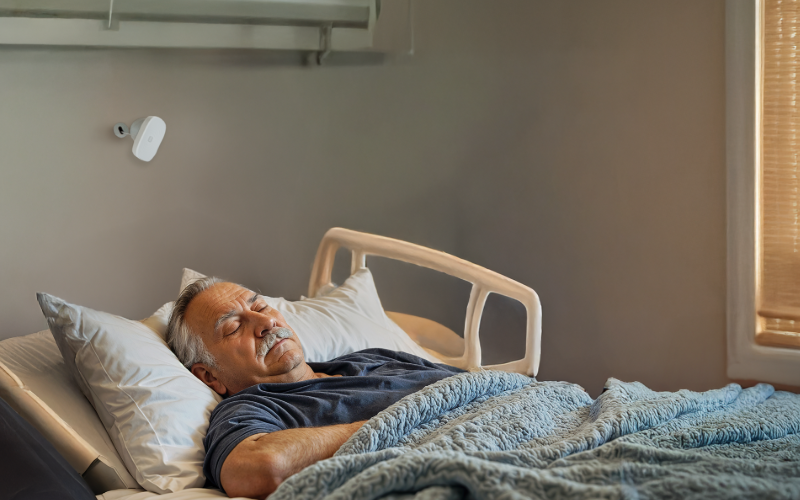
The Case for Contactless Monitoring
No compliance problem. When patients don’t have to do anything, compliance isn’t an issue. There’s nothing to forget, remove, lose, or refuse to wear.
Ideal for vulnerable populations. Contactless vital sign monitoring addresses the fundamental limitations of contact-based methods for patients who can’t tolerate traditional devices: neonates, burn patients, elderly individuals with fragile skin, patients with dementia who remove devices, and those with sensory processing issues.
Continuous, passive data collection. These systems can monitor around the clock without any patient action or staff intervention to maintain. Data flows automatically.
Lower staff burden for ongoing use. After initial setup, contactless systems typically require minimal staff involvement. No batteries to change on patient-worn devices, no adhesives to replace, no re-fitting needed.
Patient dignity, comfort, and privacy. Especially in long-term care settings, patients aren’t tethered to devices or reminded of their medical status—preserving dignity and normalcy. Radar-based contactless systems also offer a privacy advantage over camera- or audio-based approaches: they capture physiological data without recording images or private conversations, making them appropriate for sensitive settings like bedrooms and bathrooms.
The industry is moving this direction. The global market for vital sign detection radar was valued at approximately $2.5 billion in 2022 and is projected to reach $6.4 billion by 2030—a CAGR of 12.3%—driven by demand for non-contact monitoring solutions in healthcare settings. Contactless monitoring systems incorporating machine learning and AI algorithms play a vital role.
Challenges With Contactless Monitoring
Limited to certain vital signs. Current contactless technology primarily measures heart rate, respiratory rate, and movement/activity patterns. Commercially available contactless systems don’t yet offer metrics such as blood glucose, blood pressure, or detailed ECG waveforms—though radar-based blood pressure monitoring is an active area of research.
Range and positioning requirements. Most contactless systems work best when the patient is relatively stationary and within the sensor’s range. They’re not designed for ambulatory patients who need continuous monitoring.
Less established in some care settings. While contactless radar-based monitoring has demonstrated strong clinical validation—including FDA clearance and published study results—it’s newer than wearable RPM. Organizations may find fewer case studies and testimonials available from peers.
Environmental considerations. Depending on the technology, factors like room layout, multiple occupants, or patient movements may affect performance.
Where Contactless Monitoring Makes the Most Sense
- Skilled nursing facilities and long-term care
- Memory care units (where patients remove wearables)
- Post-acute care and transitional care
- ED holding areas and waiting rooms
- Hospital-at-home programs for appropriate patients
- Palliative and hospice care
- Neonatal monitoring
- Patients with skin integrity issues, cognitive impairment, or sensory sensitivities
- Telehealth programs requiring passive monitoring
Wearables vs. Contactless Monitoring: Making Your Technology Decision
There’s no universal “better” option. The right choice depends on matching the technology’s capabilities to your specific realities.
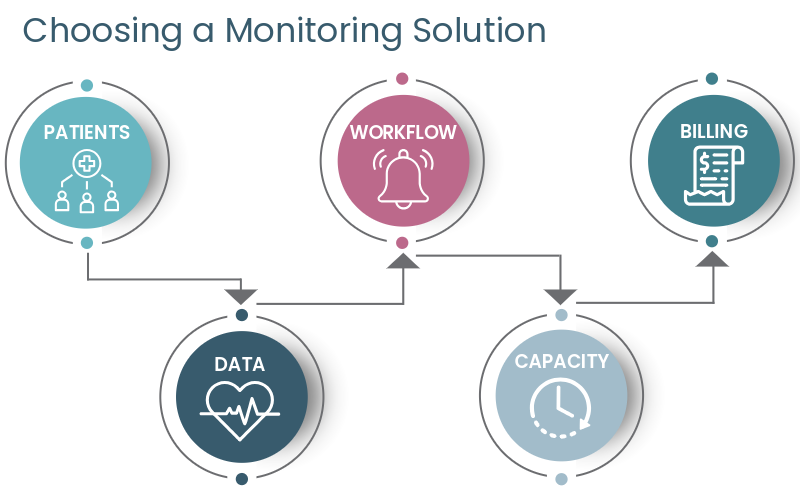
Start with your patients. Consider their age, cognitive status, skin integrity, and mobility. Patients with dementia, fragile skin, sensory sensitivities, or those who are primarily bed-bound point toward contactless. Mobile, engaged patients who can manage a device point toward choosing wearables.
Consider what you need to measure. Heart rate, respiratory rate, and movement? Both approaches work. Blood glucose, detailed ECG waveforms, or monitoring during physical activity? Wearables are your path.
Factor in your care setting and workflows. A SNF or memory care unit has different demands than a cardiac rehab program. How will data integrate with your EHR? How will alerts reach clinical staff? Who responds and how? Also consider alert fatigue: continuous monitoring can overwhelm staff regardless of technology type. Look for solutions that allow customizable alert thresholds, baseline deviation alerts (not just fixed limits), and tiered escalation. Ask vendors about false alarm rates in settings like yours.
Be realistic about your team’s capacity. Wearable programs may pilot faster in some cases—you’re distributing devices with minimal infrastructure. But they create ongoing work: fitting, educating, replacing, and troubleshooting. Contactless systems may require sensor installation and IT configuration upfront, but typically demand less day-to-day management once deployed.
Understand reimbursement requirements. RPM reimbursement is tied to the service provided, data collected, and patient engagement—not the specific technology used. Both wearables and contactless systems can qualify under current CPT codes, provided the device is FDA-cleared and automatically transmits physiologic data. The key billing requirements include collecting at least 16 days of data in a 30-day period and documenting interactive patient communication for care management codes.
Choose wearables when:
- You need specific vital signs that only wearables can measure
- Your patients are mobile, and monitoring them during activity matters
- You’re working with engaged patients likely to comply
Choose contactless when:
- Compliance is a barrier to wearable programs
- Your population includes patients who can’t tolerate worn devices
- You are monitoring patients who are primarily resting or in bed
- Reducing staff time for device management is a priority
- Patient movement and occupancy information is important