


A Continuous Monitoring Implementation Roadmap for SNF and Post-Acute Care Leaders
Intermittent vital sign checks are the standard in skilled nursing facilities. They also create one of the biggest blind spots in post-acute and long-term care.
Most skilled nursing facilities (SNFs) and post-acute care programs assess residents on a scheduled basis, typically every four, eight, or twelve hours. That’s a lot of time between data points for a resident population that is older, sicker, and more likely to experience changes in condition.
With nurse-to-resident ratios under pressure and overnight coverage especially slim, manual spot checks are increasingly difficult to sustain.
Continuous patient monitoring can close that gap. But technology alone doesn’t change outcomes. How you implement it does.
This guide walks post-acute and long-term care clinical leaders through a practical three-phase implementation roadmap, including the change-management decisions that can be underestimated in technology rollouts.
Why Most SNF Continuous Monitoring Programs Stall Before They Succeed
Continuous monitoring technology for SNFs and long-term care settings has matured significantly. Wireless, contactless, and wearable options exist across a range of price points and clinical use cases. Technology is no longer a barrier.
What commonly derails implementations isn’t the device; it’s the deployment. Staff suffering alert fatigue from poorly calibrated alert parameters. Frontline staff who weren’t included in the design. Protocols that work on paper but don’t survive a busy overnight shift. Families who see a device near their loved one’s bed and have no idea what it does.
Successfully implementing continuous monitoring in SNFs requires three things working together: the right technology, a phased rollout, and structured change management at every stage.
Every facility starts from a different place. The timelines below reflect a realistic sequence, but your actual pace depends on infrastructure readiness, vendor selection, staffing capacity, and organizational complexity.
Phase 1: How to Evaluate Continuous Monitoring Technology for Your SNF
Not all continuous monitoring solutions perform well in a post-acute environment. Your evaluation criteria need to reflect your reality.
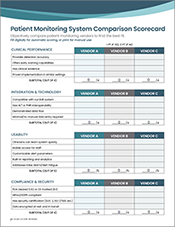
Choosing the Right Patient Monitoring System Includes Asking Vendors the Right Questions
This informative article includes useful guidance on choosing a patient monitoring system, including an interactive scorecard to compare vendors against essential criteria.
In-house or outsourced? It’s the first decision to make
Before you evaluate monitoring technology, answer a more fundamental question: who will own the monitoring function once the system is live?
There are two models, and they lead to very different evaluation processes.
In-house means your clinical team is the monitoring team. Your staff receives and reviews continuous trending data, responds to alerts, and integrates monitoring insights into care planning, shift handoffs, and clinical documentation. Done well, this model supports earlier intervention, stronger care plan documentation, and the kind of resident visibility that helps your team reduce readmissions and improve quality performance. It also gives you direct control over protocols and the tightest integration with your existing workflows.
A service partnership is a fundamentally different decision. Some service providers offer continuous monitoring as an embedded feature of their offering. The monitoring function, technology, clinical oversight, and alert triage may be built into the service, depending on the provider. If this model fits your organization, your evaluation shifts from technology procurement to choosing a service provider.
Neither model is universally right. The in-house model suits facilities with the staffing capacity and clinical champions to sustain consistent engagement with monitoring data. A managed service partnership is worth evaluating seriously if overnight coverage is lean, if your organization is earlier in its monitoring adoption, or if you want experienced clinical oversight while building internal confidence with continuous monitoring.
Your operating model decision should drive everything that follows, including which vendors and service providers belong on your evaluation list.
When reviewing vendors, focus on:
- Clinical evidence
Ask for peer-reviewed publications that support performance in older adult populations with complex comorbidities.
- Integration capabilities
Can the system route alert notifications to your existing workflows, and does it connect to your EHR? Manual transcription errors in vital sign documentation are a known problem that can be reduced by the right solution.
- Total cost of ownership
Look beyond device cost. Factor in installation, training, ongoing support, and staff time needed to manage the system.
- Alert parameter flexibility
One-size-fits-all alert configurations won’t be ideal for your resident population and staffing model. Too many false alerts, and the system will be ignored. Parameters that are too permissive may not detect clinical changes when they matter.
- References from similar facilities
Vendor references from acute care hospitals don’t translate to post-acute realities. Ask specifically for SNF or post-acute sites.
Most monitoring vendors offer pilot programs. Use Phase 1 to identify the right partner before committing, and plan for a structured pilot before any broad rollout.
Phase 2: Running a Continuous Monitoring Pilot in Your Skilled Nursing Facility (Months 3–4)
Choose a high-acuity, high-risk resident population for your pilot. This gives you the clearest signal about whether the technology works as intended, and shows you where your workflows need adjustment.
The two decisions that most affect pilot success:
1. Monitoring profile selection: Most continuous monitoring systems offer configuration profiles that balance detection sensitivity against notification volume. A higher-sensitivity profile catches more potential clinical changes but generates more alerts. A focused profile reduces notification volume while maintaining awareness of meaningful changes. For SNFs with limited overnight staffing, a lower-volume profile is often the right starting point. The goal is notifications that your team can consistently respond to.
2. Clinical champion identification: Don’t make the mistake of choosing technology enthusiasts. Identify two to three respected clinicians per unit who are trusted by their peers for their clinical judgment. Champions who can translate the value of continuous monitoring are vital to your frontline staff’s adoption.
What to watch during the pilot:
- Alert response times and patterns
- Whether staff feel supported or burdened by the new workflow
- Questions and concerns from residents and families
- Whether overnight and weekend workflows also hold up
Ask for feedback from nursing staff throughout the pilot, rather than waiting until the end. Small workflow barriers that seem minor in week one become adoption killers by week eight. Identifying these earlier gives your vendor and your team an opportunity to resolve them while the pilot progresses.
| Higher Sensitivity | Lower Notification Volume SNF Default | |
|---|---|---|
| Detection | Catches more potential signs of clinical change, including borderline readings More alerts |
Focuses on clinically meaningful changes; filters borderline readings Fewer alerts |
| Notification Volume | Higher — requires consistent staff capacity to respond | Lower — manageable for teams covering multiple units |
| Best For | Higher-acuity residents; facilities with staffing capacity to respond consistently | Stable populations; limited overnight staffing; pilot deployments |
| Key Tradeoff | Greater coverage, but alert fatigue risk if notification volume exceeds staff capacity | Reduced false alerts, but fewer borderline changes flagged for review |
Profile selection should reflect your resident acuity and staffing model. There is no universally correct choice. The right profile is the one your team can clinically sustain.
FROM THE FIELD
At one SNF, a resident appeared completely stable during routine rounds: alert, verbal, warm, and dry. Nothing that would have flagged during a scheduled check. But the Neteera System tracked an upward trend in respiratory rate over 24 hours. This alerted the nursing staff to assess further. Finding diminished breath sounds and an SpO2 of 91% were found, the clinician notified the physician. Imaging came back showing bilateral opacities and early signs of pulmonary edema, two serious, overlapping conditions that were caught early enough to diagnose and treat in place, without a hospital transfer.
This is an example of what a well-run pilot can reveal: not just whether the technology works, but what it catches in the time between scheduled rounds.
How the Neteera System Supports This Approach
The following reflects how the Neteera System can be configured for SNF environments. It's intended as a practical reference point as you think through profile selection and alert structure for your facility.
Choosing a Monitoring Profile
One of the first configuration decisions your team will make is selecting a monitoring profile. The Neteera System offers two starting profiles. Neither is universally correct. The right choice depends on your resident acuity and your team's capacity to respond to notifications.
| Comprehensive Profile | Focused Profile SNF Default | |
|---|---|---|
| Detection sensitivity | Higher | Lower |
| Notification volume | More alerts, including borderline changes | Fewer alerts, focused on meaningful changes |
| Best for | Higher-acuity residents; staffing capacity available to respond | Stable populations; limited overnight staffing; pilot deployments |
For most SNF pilots, the Focused Profile is the right starting point. It maintains clinical awareness while keeping notification volume manageable for teams covering multiple units on night shifts.
How Alert Types Map to Detection Windows
Understanding how the system detects change helps your team set realistic expectations during the pilot and respond appropriately when notifications arrive. The Neteera System uses three alert types, each operating across a different detection window.
Threshold Alerts— Real-time detection
Trigger when heart rate or respiratory rate crosses a fixed, facility-wide limit. These support awareness of potentially acute, rapid physiological changes.
Baseline Deviation Alerts— Hours-based detection
Compare each resident's recent vital signs against their own baseline, not a population norm. In older adults with chronically abnormal vital signs, standard limits may miss changes that are clinically significant for that individual.
Percentage-of-Change Alerts— Days-based detection
Track a sustained directional shift in vital signs over multiple days. These support earlier intervention before acute changes occur and are the alert type most closely associated with a wider early warning window.
Phase 3: Scaling Continuous Patient Monitoring Across Your Facility (Months 5–6)
Expanding beyond the pilot unit is where many implementations stumble. Expanding systematically keeps the project on track and requires three things:

Advancing one unit at a time with a formal readiness review between each

Treating each new unit as its own implementation rather than assuming pilot settings transfer cleanly

Keeping early units in an active feedback loop until the program is genuinely stable, not just live
Timing is illustrative. Adjust intervals based on your facility's readiness, organizational complexity, and existing change management infrastructure.
Four execution priorities determine whether adoption takes root on each unit:
Differentiated staff training, not a single all-hands session. Each staff role interacts with the monitoring system differently and needs training that reflects that. A single in-service won’t cover these needs well. Training designed around how each role actually uses the system significantly improves the odds that adoption succeeds.
Every vendor trains differently. The framework below illustrates Neteera’s approach. These role-specific focus areas are worth building into any continuous monitoring training plan
| Role | Training Focus |
|---|---|
| Bedside nurses | Alert response, device basics, and resident communication |
| Charge nurses | Alert parameter review, escalation protocols, and troubleshooting |
| Physicians and APPs | Alert context, vital sign parameters, and clinical decision integration |
| CNAs | Device awareness and what to report to nursing |
| Nurse managers and directors of nursing | Dashboard navigation, data review, and reporting |
Shift handoff integration
Continuous monitoring data only drives clinical action if it’s part of how care gets handed off between shifts. Build a brief review of any alert activity during the monitoring period into your standard bedside handoff process. If it’s not in handoff, it won’t be acted on.
Resident and family communication
Residents and families will notice the monitoring device. Prepare staff with consistent, simple language: what the device does, how it works, and what it doesn’t do. Your vendor may have suggested messaging they’ve seen work in other facilities. Families who understand the technology become allies. Families who don’t can become sources of resistance and concern.
Documentation workflow clarity
Before you reach go-live, define how monitoring notification responses get documented in your EHR. Discovering holes in that process after the fact creates compliance risks and quality-improvement blind spots that are hard to close.
FROM THE FIELD
Not every catch is a dramatic clinical event. A Neteera alert flagged an elevated respiratory rate in an oxygen-dependent resident. Staff discovered the resident had removed their oxygen to use the restroom but hadn’t replaced it when they returned to the bed. For a resident with that level of oxygen dependency, even a short gap in supplemental oxygen carries real clinical risk. Because staff responded to the alert quickly, the situation was resolved before it could progress. Both an incident report and a transfer were avoided.
In a fully implemented program, surveillance can have fewer crises, greater value, and deliver care with the precision no scheduled round can replicate.
What Separates Successful Continuous Monitoring Implementations from Stalled Ones
Your Five-Step Checklist for Implementing Continuous Patient Monitoring in Your SNF
Before you meet with your first vendor, get these five things in order:
-
- Establish your baseline. Document your current readmission rates, hospitalization patterns, and staffing structure by shift. You can’t demonstrate improvement without a starting point.
- Identify your champions. Find clinical staff in each unit who are respected for their clinical competence and willing to be early adopters.
- Evaluate vendors against post-acute criteria. Ask for evidence, SNF references, and a live demonstration with your care setting in mind. This information can help you ask the right questions and compare your options.
- Target your pilot. Choose a unit, a resident population, and a timeline. Some resident conditions may show immediate results, while others may take time. Define what success looks like before you begin.
- Prepare for change management. Budget time and support for staff training, communication, and workflow redesign, not just device installation.
Continuous Patient Monitoring in Skilled Nursing Facilities Is No Longer Optional
Continuous monitoring for skilled nursing and post-acute care is no longer experimental. Gaining around-the-clock awareness, enabling clinical teams to intervene earlier, and meeting resident and family expectations have clinical, financial, and operational benefits.
Avoidable readmissions also have reputational consequences under value-based care and CMS quality rating systems. Most SNF and post-acute leaders are no longer asking whether to implement continuous monitoring; instead, they’re asking how to do it without disrupting their care environment and stretching their staff even further.
The answer is a phased, structured approach that treats change management as a clinical priority, not an afterthought.
Want to see how continuous monitoring fits into your facility’s workflow? Schedule a conversation to see how Neteera can support your team, residents, and families.