

What Is Continuous Monitoring in Skilled Nursing Facilities?
Continuous monitoring provides around-the-clock visibility, giving care teams a real-time view of each resident’s status between scheduled rounds. Early detection of decline in skilled nursing facilities depends on data continuity, helping care teams identify subtle physiological changes that can otherwise develop undetected for hours or days. The earlier a care team sees a pattern, the more options they still have.
Why SNFs Are Structurally Vulnerable to Missing Early Warning Signs
The challenge isn’t that clinical teams aren’t paying attention. It’s that the traditional model of care creates gaps that no amount of attentiveness can fully close.
Nursing rounds happen on a schedule. Vital sign checks are intermittent. Nights and weekends bring reduced staffing ratios. A resident showing subtle physiological changes at 9 p.m. on a Friday may not have those changes recognized until Monday morning. By then, what could have been manageable is now a transfer.
This isn’t because of clinical skill. It’s a structural limitation of periodic monitoring in a setting where health status can shift continuously. The question is whether there’s a better model.
What a 612-Patient Study Found on Early Detection of Deterioration in SNFs
A joint efficacy study conducted by TapestryHealth and Neteera, involving 612 patients across five nursing facilities, suggests there is. Continuous monitoring detected 77% of health deterioration events an average of five days before hospitalization became necessary.
Five days isn’t a narrow window. It’s a clinical opportunity to change the outcome.
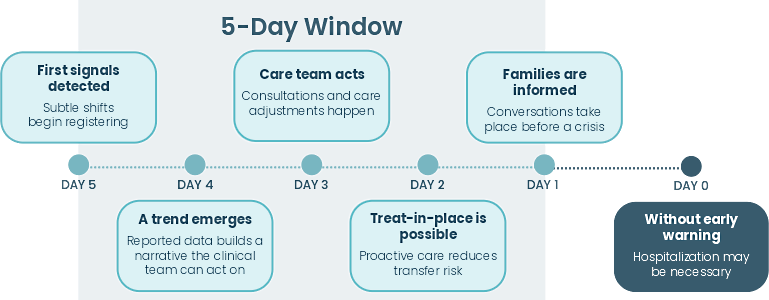 Think about what a care team can accomplish with that kind of lead time. Care teams can consult doctors and specialists before a situation becomes urgent. Clinicians can adjust medications and treatment plans while the resident is still stable. Families can be brought into the conversation early, before a transfer happens without warning. And in many cases, the right intervention at the right moment means the resident never leaves the facility.
That last point matters more than it might seem. Respiratory rate changes, subtle variations in heart rate patterns, patterns in restlessness: these are the kinds of signals that rarely trigger a call to the physician at 2 a.m., but when tracked over days, tell a story about where a resident is heading. Continuous monitoring turns those signals into a clinical narrative that the care team can act on while options are still open.
The Real Cost of Unplanned Hospitalizations in Skilled Nursing
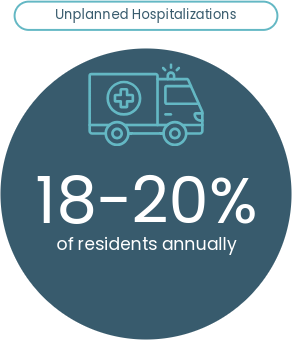
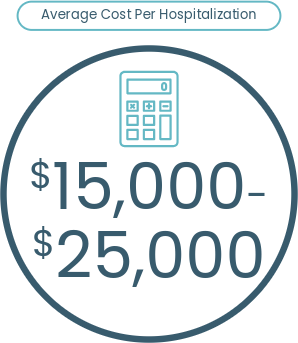
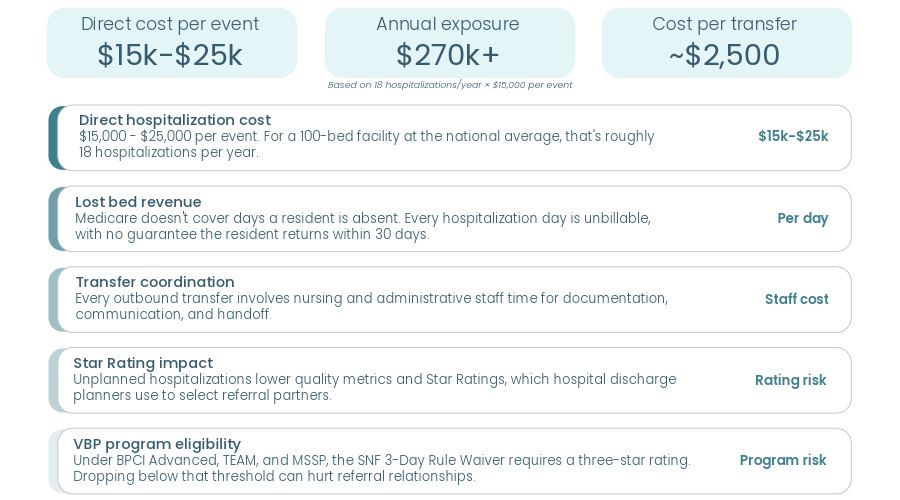
The $15,000–$25,000 hospitalization figure is cited often, and it should be. For a 100-bed facility running close to the national readmission average, that’s a recurring hit, every month. But direct hospitalization cost is only part of the picture.
Medicare does not cover the days a resident is absent from the facility. For every day of hospitalization, the facility bears that loss, with no guarantee that the resident will return within the 30-day window that allows billing to resume, or return at all. Even transfers that don’t result in full hospitalization carry an estimated cost of around $2,500 each in coordination, documentation, and staff time.
The financial exposure doesn’t stop there. Unplanned hospitalizations drag down CMS quality metrics, which shape Star Ratings, which hospital discharge planners actively weigh when selecting referral partners. Under value-based programs, including BPCI Advanced, TEAM, and MSSP, the SNF 3-Day Rule Waiver requires a three-star rating to remain eligible. Drop below that threshold and those referral relationships follow.
How SNFs Are Moving From Reactive to Proactive Care
The monitoring model most SNFs rely on today was built for a different era of care delivery. The evidence for a better approach isn’t theoretical; it’s documented in clinical outcomes and financial data in the facilities already using continuous monitoring to close the gap between what care teams can see and what’s actually developing in their residents. The shift from reactive to proactive care starts with better visibility. For SNF leaders, early detection of decline in skilled nursing facilities starts with better visibility.